Unifying Numerai and Signals
Revealing the stocks and uniting the Meta Models
For ten years, every row in Numerai’s dataset was an anonymous stock. You never knew whether you were predicting Apple or a small-cap miner in Perth. Starting today, you do.
Numerai and Numerai Signals have always shared the same goal: use frontier AI to find alpha in global equities, and stake NMR on successful models. The only real difference was the data: Numerai gave you obfuscated features with the tickers hidden, while Numerai Signals asked you to bring your own features. With Unity, that difference disappears.
Today we’re announcing the unification of Numerai and Numerai Signals. We’ve built a new dataset called Unity with 1,040 features and real stock identifiers. This dataset doubles the NCORR of the Numerai Signals benchmark model over the validation period. The Unity dataset is the base dataset for both tournaments.
The challenge is to build agentic research pipelines that model the base features and your own features. Both tournaments will use the Jupiter target and neutralizers currently available on Numerai Signals. The features themselves stay ranked, normalized, binned and unnamed. What changes is that every row is now a real company.
For the next few months, the tournaments will be essentially the same but run separately; on January 1, 2027 they’ll merge into one tournament with one Meta Model.
Your agents can now work on the whole problem
There are essentially two parts to building a quant signal: feature engineering and modeling.
Agentic research is growing rapidly on Numerai with 77,000 MCP sessions since July and over 30,000 sessions in the last 30 days. On Numerai, these research agents only get to focus on half the problem – modeling. This limits the types of intelligence that can be rewarded.
The Unity dataset allows agents to work on the whole problem. This unlocks the ability for agents to source and engineer new features and each new feature set developed from diverse sources multiplies the modeling possibilities: a technique that works on our numeric features may fail on text features that you derive. The right model depends on what you bring.
With real stock ids, your agents can reveal risks, measure churn, model specific sectors and regions, forecast time series, and bring in any data they can find.
One prompt, three new features
Here is what that looks like in practice. One of our researchers gave Claude a three-step prompt: pull earnings releases from SEC’s EDGAR, have a small open-weight LLM score them, then rank and bin the scores and join them to the Numerai Signals data.
The prompt:
Let's make some new Signals features.

My idea is that we can read public filings, and run them through an LLM and ask some questions to generate features. You'll need to

1. pull filings from EDGAR

2. pass them through a free, cheap JEV-like LLM (Kev: https://github.com/jaredpalmer/kev, for example), scoring on a scale of "buy" to "don't buy"

3. rank and bin those scores per era and join them with v3.1 Unity data
Claude set up Kev-4B, an open-weight model, locally and wrote the pipeline. It maps each “numerai_ticker” to its SEC filer, pulls each company's earnings press releases, strips out the numbers, and hides the company's name to avoid bias. Kev then answers three questions: how results compare with a year earlier, how strong the outlook is, and how positive the tone is. For each date, the pipeline uses only the latest release filed before it, then ranks and bins the answers exactly like every other Numerai Signals feature.
The result is three new point-in-time features across the US universe, and it cost just $33 in Claude Opus 5.5 tokens to build.
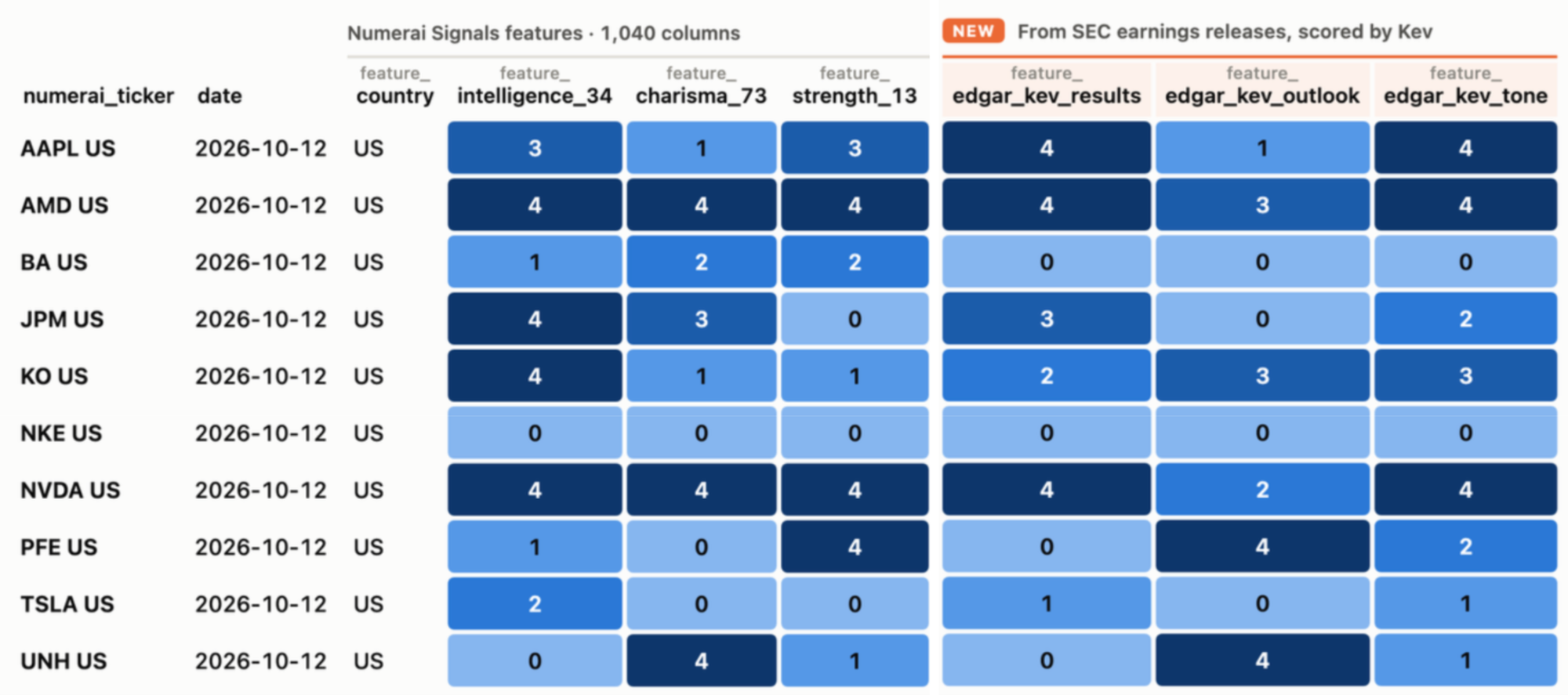
The modeling still has to be done: whether these features add anything, how they interact with the 1,040 we already provide, and which models suit text-derived signals. But it’s easy to imagine how this scales with frontier AI – anyone can build thousands of their own features, which would have taken a large team when Numerai Signals launched in 2020.
What happens when
What you should do
Numerai and Numerai Signals users can begin modeling the 1,040 features in the Unity dataset today.
Numerai users can continue to submit their existing models normally until November 6th. By November 6th, be ready with a new model retrained on the Unity dataset. Although Unity has fewer features than Numerai today (1,040 vs 3,555), you can join your own features to it. Numerai will add new features to the base dataset as we get permission from data vendors. In time, the base dataset may exceed the size of Numerai’s today.
Numerai Signals users can continue submitting normally and the migration path from Numerai Signals to Numerai will be announced in 3 weeks. If you have extra NMR, you can submit and stake your Numerai Signals model on Numerai starting November 6th because the targets, neutralizers and churn penalty will be exactly the same across Numerai and Numerai Signals on that date. The only difference will be that Numerai staking uses Atomic Blockchain Staking.
One tournament, one Meta Model
We see a world where Numerai users build giant fleets of agents to source all the features in the world, run agentic modeling at scale, aggregate all of that intelligence into one Numerai Meta Model, and get rewarded for positive contributions.
For ten years we hid the stocks, because that was the best way to bring the world’s intelligence to the market. In a world of agents, the best way is to show them. Unity is the first step: one dataset, one tournament, one Meta Model.
Start modeling Unity today, read the forum post, and register for our fireside chat about Unity on Monday, October 19, 2026 at 9 AM Pacific.