One Prompt Generates 1,400 Features
Every row in the Unity dataset has a real stock ticker, giving every agent the power to engineer their own features in addition to the base features we provide. The base features give a point-in-time snapshot of a stock, but none of them contain information about that stock’s recent history. This means every feature may have untapped alpha in its past.
One of our researchers asked Claude to turn that history into new features. Starting with one prompt, Claude produced 1,400 new features, taking an example model from 1,040 to 2,440 features, and achieving high Neutral Benchmark Contribution (NBMC) over the validation period.
This is the power of agentic feature engineering on Unity.
Four Questions for Every Feature
With tickers, you can ask how a stock today compares to its own past. For example, here is one Unity feature for Nike from 2021 to 2025, sitting near the top of the 0–4 range almost all the time, with its 13-week and 52-week averages:
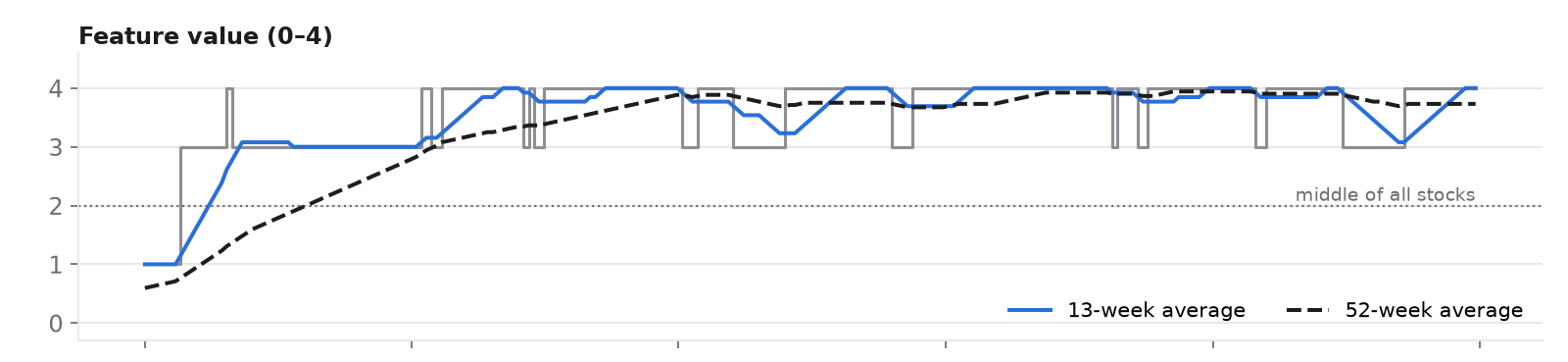
Against other stocks, Nike almost always looks high on this feature. But, with a simple moving average, you can ask many more questions about Nike relative to its own recent history.
Here are four different questions yielding four different views of the same feature:
Is this high for this company?
We can rank today's value against its historical values across the last 52 weeks, yielding an "own-history rank". This can tell the models whether this stock is doing well right now relative to itself. A "1" would indicate that it's doing well for its history and a "0" that it's doing poorly.

Which way is it moving?
We can compare the two different moving averages (13-week vs. 52-week) by taking the difference between them. This "moving-average crossover" can indicate the direction the stock's ranks are starting to move. A "1" means its ranks are going up and a "-1" means they're going down.

How long since its peak?
Simply count the weeks since the stock's own 52-week high. This may help predict reversals and cyclical patterns when used in combination with other features.

How fresh is it?
Weeks since the value last changed. This may help detect staleness in the values and potential for changes in other features.
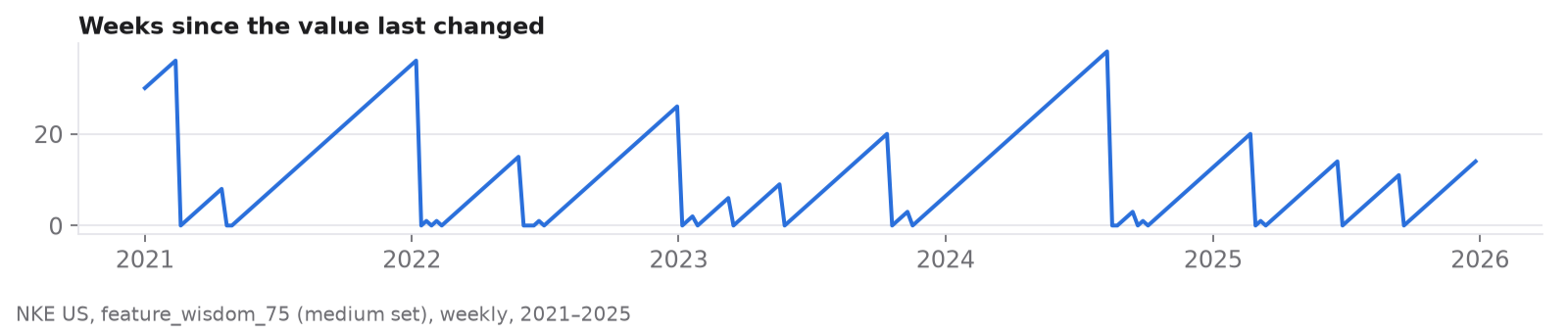
We've just built four new features from a single feature's history for Nike. You can now clearly see when it is high or low for Nike over a given period, the directionality of the values, and whether the value is peaking or stale.
Doing this for every stock and every feature yields a massive increase in total features. After some basic filtering, we were able to generate an additional 1400 features from a single prompt.
The Prompt
Let's build new features from the Unity data.
For every feature in the "medium" feature set and every ticker, using only that ticker's own past up to each date:

1. rank today's value within the ticker's last 52 weeks
2. take the 13-week average minus the 52-week average
3. count the weeks since the ticker's 52-week high
4. count the weeks since the value last changed

Compute all dates at once, rank and bin each new feature 0–4 per date like the Unity features, and join them on numerai_ticker and date.
Claude Opus 5.5 wrote the pipeline and filtered the features down to the most useful ones. This produced 350 features × 4 transforms = 1,400 new features, for every stock and every week back to 2003. In total, the whole process cost us roughly $30 in tokens.
Tips for your agent:
- Only look back. Every window ends at the current date. Ranking against a stock's full history leaks the future.
- Respect short histories. A new listing has no 52-week past. Leave those values missing rather than inventing one.
- Rank and bin per date. Put new features on the same 0–4 scale as Unity.
- Pick different questions, not more windows. The same transform at 52 and 156 weeks is mostly a copy. A few distinct ideas on fixed horizons beat a grid of variants.
- Score what pays. Judge new features on NCORR and neutral BMC against the benchmark, not on how they look alone.
- Transforms aren't all you need. Transforms often re-express what Unity already knows. They make your model different from everyone else's, which is exactly what NMMC rewards, but they may not tell it anything new.
- To raise NCORR, bring new information: filings, news, alternative data, like the EDGAR features from our Unity announcement. If your agents can find it and join it on numerai_ticker, it becomes a feature, and its history gives you four more.
The full time-series example is available right now in our Example Scripts Repository. You can point your agents to it now and re-create these features yourself.
An Edge Over the Benchmark
We trained the same LightGBM model on Unity alone and on Unity plus the new features, then scored both on validation (2019–2026) with the two scores that matter: NCORR and Neutral BMC.
NCORR
The neutral correlation of the predictions with the “Jupiter” target.
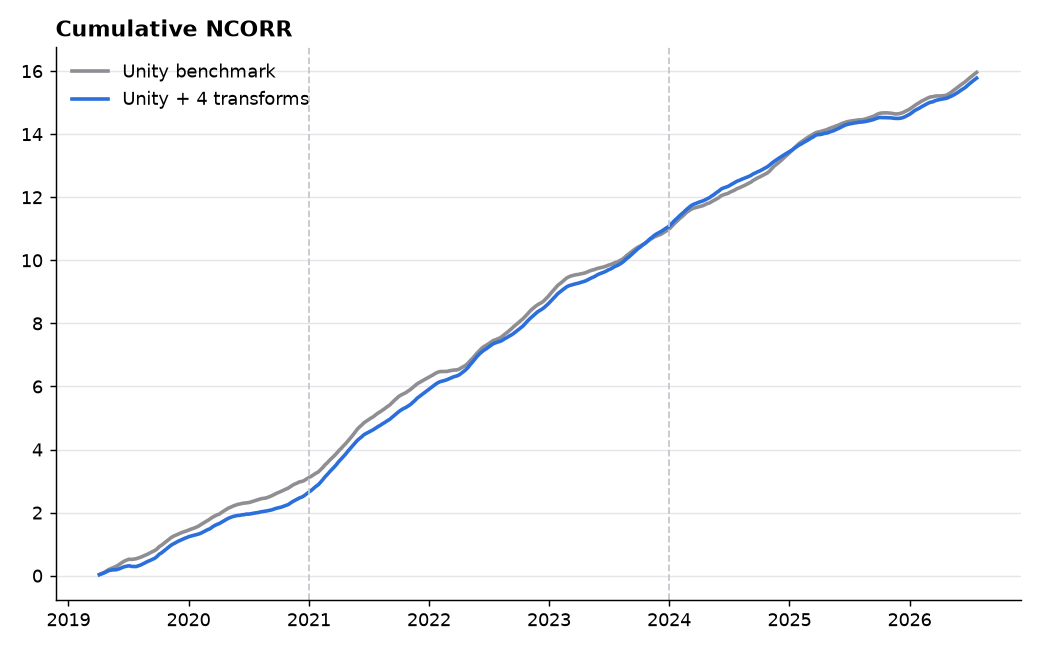
Both models track each other closely with the new transforms achieving similar NCORR Sharpe. This is the most basic measure of a model’s value, but it’s easy to re-create. We give out a free 30k tree LGBM model as a benchmark, so it’s not valuable to just have NCORR, you need NBMC.
Neutral Benchmark Model Contribution (NBMC)
The neutral contribution of the predictions with respect to the public benchmark model and the “Jupiter” target. This is typically the offline proxy for NMMC in our tutorials and indicates the model’s value that is not already covered by our free benchmark predictions.
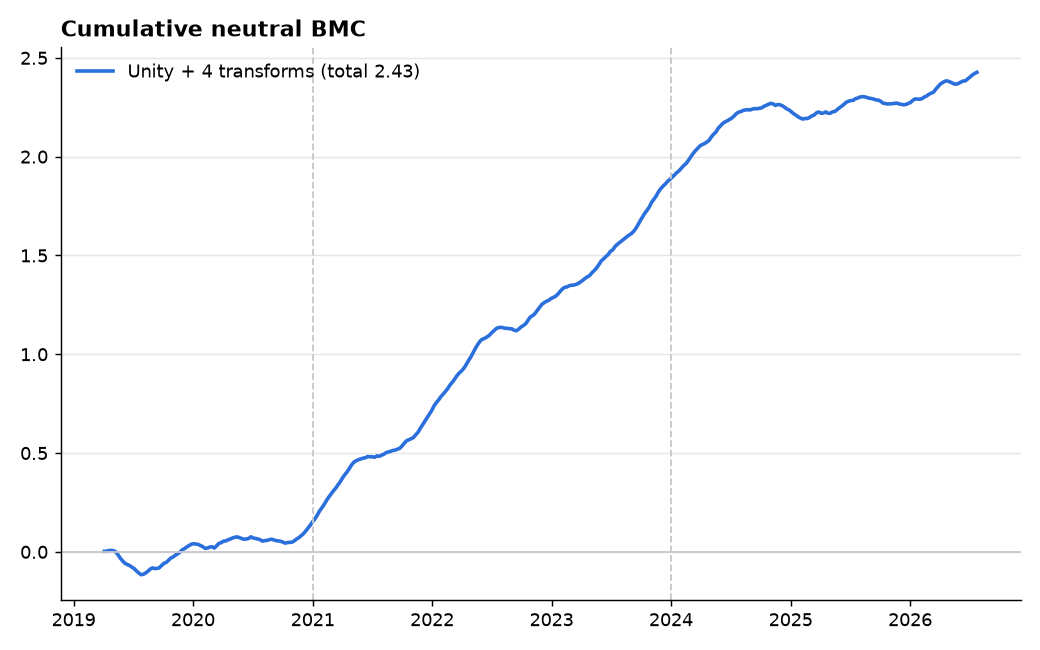
The “Unity + 4 transforms” data reaches 2.43 Neutral BMC by 2026. That unique part is similar to what NMMC pays for, and NMMC carries 4× the weight of NCORR in payouts (0.5 × NCORR + 2 × NMMC).
The value here is clear: the Unity data is the perfect platform for agents to contribute every bit of intelligence they can, guided by the expert AI architects playing the Numerai tournaments. Every prompt and tool that we add to our open-source repositories multiplies that value.
The Tournament Roadmap
The Agentic revolution is here and we are preparing a roadmap to match. When Numerai switches to Unity submissions, scores, and payouts on November 6, we will be publishing some of the ideas we have for the future of the tournaments including the Signals merge plan, onboarding overhauls, decentralization, the importance of NBMC, and updates on other tournaments.
Join our Discord today to be the first to know when the roadmap is released.